Theremin
Name
Theremin (originally known as the ætherphone, etherphone, thereminophone, termenvox, or thereminvox)
Pronunciation
/ˈθɛrəmɪn/
History
The theremin was produced by research into proximity sensors sponsored by the Soviet government. A Russian physicist named Lev Sergeyevich Termen (known in the west as Leon Theremin) invernted the instrument in October of 1920. After creating the Theremin, he went on a lengthy tour around Europe to demonstrate his invention. Eight years after the tour ended, Termen moved into the United States of America where he patented the theremin and granted commercial rights to the R.C.A (The Radio Corporation of America) Shortly after the stock market crash of 1929, RCA released the Thereminvox where not many people bought the thing, but many were interested in it. Although it never really picked up, people such as Clara Rockmore (with Paul Robeson), and Musaire (real name: Joseph Whiteley) toured across America playing the intrument. The popularization of the theremin can be traced back to Lucie Bigelow Rosen and her husband Walter bigelow Rosen in the 1930s. later, in 1938, Termen left the USA, while his circumstances are unconfirmed, some say he was taken from his apartment in NYC by NKVD agents (preceding the KGB) and was taken back to the Soviet Union to work in a sharashka laboratory prison camp at Magadan, Siberia. He mysteriously reappeared in 1968. While that is a fun theory to believe, Albert Glinsky wrote a biography titled, "Theremin: Ether Music and Espionage", where he suggested that Termen had fled NYC to escape problematic personal debts, and he then got caught up in Stalin's political purges. Either way, Termen eventual turned back up in the US in 1991 for unknown reasons. While away, after WWII, focus in america turned to entertainment, where the Theremin was viewed in a more serious tone by real musicians. One of these theremin inthuseists was named Robert Moog, and he began building many theremins throughout the 1950s while he was in highschool. Moog also published several articles about his replications, and they gained more attention than he had expected, causeing him to start selling assembleble theremin kits. Around a year after he graduated (in 1955), with the credit of the theremins, he made a groundbreaking discovery, a synthesizer he named the Moog.
Instrument Family
Hornbostel-Sachs classification: Electrophone
Date or Era
invented October 1920, but popularized in the 1930s where it later died out in the 1950s due to easier to play electronic instruments.
How It's Played
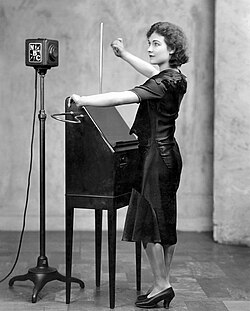
While the theremin is played with no physical contact, the thereminist stands infront of it where they move their hands in proximinty of two metal antennas (NOT radio antennas, but rather act as plates of capacitors). The distance from one antenna determines frequency (pitch), and the other controls amplitude (volume). Closer to the antenna translates to louder and higher, while further causes the opposite.
Materials
The controlling seciton usually contains two metal antennas where each one forms half of a capacitor. The elevtric signals from the theremin are amplified and sent to a loudspeaker.
Sound Description
Often associated with eerie situations but Harold C. Schonberg described the sound as "[a] cello lost in a dense fog, crying because it does not know how to get home."
Range / Pitch
typically five octaves, from around C2 to C7, but the overall theoretical range can span up to eight octaves (from A0 to A7)
Difficulty
classificaiton (1-5 where 5 is hardest): initial sound production, intonation + pitch control, physical ergonomics + agility, independence of motion, notation + sight-reading complexity: 5 / 5 / 5 / 4 / 2
Audio
Audios on PixabayImages
Images on ShutterstockInteresting Facts
1) You can see, play, and hear famous musician, Musaire's 1930 RCA Theremin at the Musical Museum, Bentford, England. 2) in 2924, Andrei Pashchenko wrote the first orchestrral composition design specifically for the theremin, he called it, "Symphonic Mystery" although, its sheet music was forever lost after his second performance.